

28 AUGUST 2026 · BY SITCHEZ SIMONE
Great Migration Safari: When and Where to Go
The Great Wildebeest Migration is one of Africa's most spectacular wildlife experiences. But it is often misunderstood as a single event that happens in one place at one time.
In reality, the Great Migration is a year-round natural cycle involving millions of wildebeest, along with large numbers of zebra and gazelles, moving through the Serengeti-Maasai Mara ecosystem in search of fresh grazing and water.
That means the best place to see the Migration depends largely on when you travel.
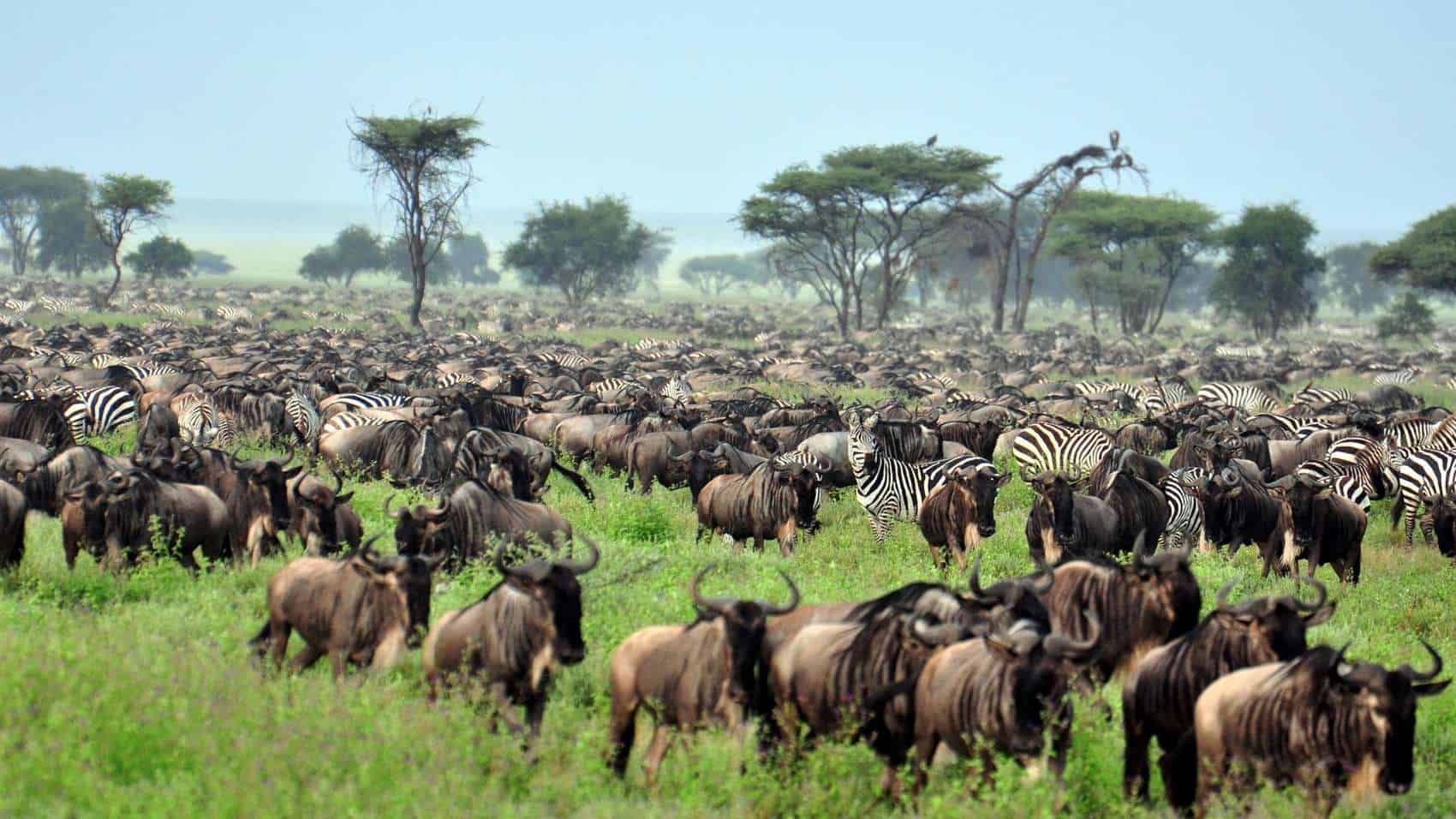
- Want to see newborn wildebeest and intense predator action? Consider January to March in southern Tanzania.
- Want to see the famous Mara River crossings? August and September are generally the strongest months to consider, although crossings are never guaranteed.
- Looking for a balance between wildlife, smaller crowds and safari cost? Excellent options exist outside the busiest August period.
At Mellow Safaris, we specialize in mid-range and budget-friendly safaris and help travelers plan around the Migration without assuming that the most expensive season is automatically the best choice.
Quick Answer: When Is the Best Time for the Great Migration?
The Great Migration takes place throughout the year, but different stages occur in different parts of the Serengeti-Maasai Mara ecosystem.
| Migration Phase | Approximate Months | Main Area | What You Can See |
|---|---|---|---|
| Calving Season | January-March | Southern Serengeti & Ndutu | Newborn wildebeest, predators and dramatic wildlife encounters |
| Northward Movement | April-June | Central & Western Serengeti | Large herds, green landscapes and fewer crowds |
| Northern Migration | July-October | Northern Serengeti & Maasai Mara | Large herds, predator activity and possible river crossings |
| Return South | October-December | Maasai Mara, Northern & Central Serengeti | Herds moving south and increasingly green landscapes |
Important: These are general seasonal patterns, not fixed dates. The Migration responds to rainfall, fresh grass and water conditions, so the exact location of the herds changes from year to year.
Best Time Based on Your Travel Priorities
- Best for calving and newborns: January-March
- Best for predator action: January-March
- Best for Mara River crossings: August-September
- Best for the Migration in Kenya: July-October
- Best for the Migration in Tanzania: January-March and July-October
- Best for avoiding peak crowds: January-March and selected shoulder periods
- Best for budget-conscious travelers: January-March, June and selected shoulder-season dates
- Best for combining Kenya and Tanzania: July-October
What Is the Great Wildebeest Migration?
The Great Wildebeest Migration is the annual movement of huge herds of wildebeest, zebra and other grazing animals through the Serengeti in Tanzania and Maasai Mara in Kenya.
The animals move in response to rainfall, fresh grass and water availability.
Rather than thinking of the Migration as a single destination, think of it as a moving safari experience.
One month the herds may be concentrated in the southern Serengeti. Several months later, they may be hundreds of kilometers farther north in the Serengeti or Maasai Mara.
This is why choosing your travel month before choosing your safari route is so important.
[IMAGE PLACEHOLDER: Map of the Serengeti-Maasai Mara Great Migration circuit showing seasonal movement]
Alt text: Map showing the annual Great Wildebeest Migration route between Tanzania's Serengeti and Kenya's Maasai Mara.
Great Migration Safari: Month-by-Month Guide
January to March: Calving Season and Predator Action
January to March is one of the most exciting periods of the Migration in Tanzania.
The herds are generally concentrated around the Southern Serengeti and Ndutu area, where seasonal rains produce fresh grazing.
This is the heart of the calving season, when large numbers of wildebeest calves are born. The abundance of young animals attracts predators including lions, cheetahs, leopards and hyenas.
For travelers more interested in wildlife behavior and predator encounters than river crossings, this can be one of the most rewarding periods of the Migration cycle.
Best area
Southern Serengeti and Ndutu, Tanzania
Highlights
- Newborn wildebeest
- Predator activity
- Dramatic wildlife encounters
- Excellent photography
- Fewer visitors than the peak Mara season in many areas
- Strong wildlife viewing
February: Peak Calving Period
February is particularly well known for calving activity.
The combination of young animals, open grasslands and concentrated predators can produce some extraordinary wildlife encounters.
If your priority is seeing the beginning of life rather than waiting for a river crossing, February deserves serious consideration.
April to June: The Journey North
After the calving season, the herds gradually begin moving northward.
April, May and June are transitional months as the Migration progresses through different areas of the Serengeti.
The exact route varies according to rainfall and grazing conditions.
This period can be attractive to travelers who want:
- Large herds
- Green landscapes
- Fewer visitors
- Strong wildlife viewing
- Potentially better value than the busiest peak periods
By June, some herds may reach the western and northern parts of the Serengeti, where river crossings can become part of the seasonal movement.
[IMAGE PLACEHOLDER: Large wildebeest herd moving across green Serengeti plains]
Alt text: Large wildebeest herd moving through the Serengeti during the northward Migration.
July to October: Northern Migration and the Maasai Mara
July marks the period when attention increasingly shifts toward the Northern Serengeti and Kenya's Maasai Mara.
In many years, large herds begin reaching the Maasai Mara around July or August, although the timing is unpredictable.
This is the period most travelers associate with the classic Great Migration safari.
July: The Migration Moves North
July can be an excellent month for following the herds through the Northern Serengeti and, depending on conditions, into the Maasai Mara.
The dry-season conditions also make this a strong period for general wildlife viewing.
August: Peak Migration Interest
August is one of the busiest months for Migration safaris.
Large concentrations of wildebeest and zebra may be found in the Maasai Mara and Northern Serengeti, while predators take advantage of the abundance of prey.
The famous Mara River crossings can occur during this period.
September: One of the Best Migration Months
September is often an excellent month for the Great Migration.
The herds can remain in the Maasai Mara and Northern Serengeti, while opportunities for river crossings may continue.
For travelers looking for a combination of large herds, dry conditions and excellent overall wildlife viewing, September is one of the strongest months to consider.
October: The Return South Begins
By October, some herds begin moving south toward Tanzania.
The exact timing varies, but Migration activity can still be experienced in the Maasai Mara and Northern Serengeti.
Even when the herds begin moving away, resident wildlife remains excellent.
November and December: The Migration Moves South
With the arrival of seasonal rains in parts of Tanzania, the herds gradually begin moving south toward the Serengeti's central and southern areas.
November and December form an important part of the annual Migration cycle even though they receive less attention than the famous river-crossing months.
The increasingly green landscapes can be beautiful, and the return south sets the stage for the next calving season.
Where Is the Great Migration?
The Great Migration moves through a large ecosystem spanning northern Tanzania and southern Kenya.
The main areas to consider are:
1. Southern Serengeti and Ndutu - Tanzania
Best time: January-March
This is the key area for the calving season.
The combination of fresh grazing, newborn wildebeest and concentrated predators makes this one of the most rewarding periods for wildlife enthusiasts.
Best for: Calving, newborns, predators and photography.
2. Central Serengeti - Tanzania
Best time: Varies depending on herd movements
Central Serengeti is an important part of the Migration route and also offers excellent resident wildlife throughout the year.
It works particularly well as part of a broader Tanzania safari rather than being treated only as a Migration destination.
Best for: Resident wildlife, predators and combining Migration viewing with a classic Serengeti safari.
3. Northern Serengeti - Tanzania
Best time: July-October
Northern Serengeti becomes particularly important as the herds move north.
This area can provide excellent opportunities to experience the Migration on the Tanzanian side before and during the period when herds move toward Kenya.
Best for: Large herds, Northern Serengeti wildlife and potential Mara River crossing activity.
4. Maasai Mara National Reserve - Kenya
Best time: July-October
The Maasai Mara is one of the world's most famous destinations for experiencing the Great Migration.
In many years, the herds arrive around July or August and can remain in the Mara through September and into October.
The Mara is also excellent when the Migration is elsewhere because resident lions, leopards, cheetahs, elephants, buffalo and other wildlife remain throughout the year.
Best for: Great Migration, potential Mara River crossings, Big Five and classic Kenya safari experiences.
Kenya vs. Tanzania: Where Should You Go?
The answer depends on when you are traveling and what you want to experience.
| Feature | Kenya - Maasai Mara | Tanzania - Serengeti |
|---|---|---|
| Main Migration period | July-October | January-March and July-October |
| Calving season | Not the main focus | Southern Serengeti / Ndutu |
| Mara River crossings | Yes | Northern Serengeti side |
| General wildlife | Excellent | Excellent |
| Best for shorter safari | Excellent | Possible, depending on route |
| Best for longer safari | Excellent | Excellent |
| Popular beach add-on | Kenyan Coast | Zanzibar |
Choose Kenya if:
- You want to focus on the Maasai Mara.
- The Mara River crossing is your main Migration goal.
- You have limited safari time.
- You want to combine your safari with the Kenyan coast.
[Explore Mellow Safaris' Kenya Safari Packages →]
Choose Tanzania if:
- You want to experience the calving season.
- You want to explore more of the Serengeti.
- You want to include the Ngorongoro Crater.
- You want to combine your safari with Zanzibar.
[Explore Mellow Safaris' Tanzania Safari Packages →]
Choose Both if:
You have enough time and budget to experience Kenya and Tanzania in one East African safari.
A combined itinerary can allow you to experience the Maasai Mara and Serengeti while also visiting other major destinations.
Can You Guarantee a Great Migration River Crossing?
No responsible safari operator can guarantee a river crossing.
The Migration follows natural conditions rather than a fixed calendar.
Wildebeest can gather along a riverbank for hours or days, hesitate, change direction or cross at another location.
Even during August and September, there may be days when no crossing takes place.
The best way to improve your chances is to spend several nights in the Migration area, use experienced local guides who monitor herd movements and remain flexible during game drives.
To maximize your chances:
- Spend at least 3-4 nights in the main Migration area where possible.
- Choose an experienced safari operator and guide.
- Stay close to the likely Migration zone.
- Allow flexibility in your daily game drives.
- Don't judge the entire safari by whether a river crossing happens.
The Great Migration is much more than a river crossing.
How Many Days Do You Need for a Great Migration Safari?
For a dedicated Migration experience, we recommend at least 4-5 nights in the main Migration area where possible.
A longer stay gives you more time to follow changing herd movements and experience different wildlife encounters.
Example: 5-Day Kenya Migration Safari
Day 1: Nairobi → Maasai Mara
Day 2: Full-day Maasai Mara game drives
Day 3: Full-day Migration-focused game drive
Day 4: Maasai Mara game drives
Day 5: Maasai Mara → Nairobi
[Explore Mellow Safaris' Maasai Mara Safari Packages →]
Example: 7-Day Tanzania Migration Safari
Day 1: Arusha → Tarangire
Day 2: Tarangire → Central Serengeti
Day 3: Serengeti game drive
Day 4: Central Serengeti → Northern Serengeti
Day 5: Northern Serengeti
Day 6: Northern Serengeti
Day 7: Continue your Tanzania safari
The exact route depends on the season, herd movements, accommodation availability and your budget.
How to Plan a Great Migration Safari on a Budget
Seeing the Great Migration does not require an ultra-luxury safari.
There are several ways to experience it while keeping costs under control.
1. Compare different travel dates
Peak August can be expensive because demand is high.
Depending on herd movements, June, July, September, October and selected shoulder-season dates may provide alternative opportunities.
Always compare actual accommodation rates for your dates rather than assuming one month is automatically cheapest.
2. Choose comfortable mid-range camps
You don't need a five-star lodge to enjoy the Migration.
Well-located tented camps and comfortable mid-range properties can provide an authentic safari experience while keeping accommodation costs more manageable.
3. Consider a group safari
Joining a group safari allows travelers to share the cost of the safari vehicle and guide.
This can make the Migration significantly more accessible for solo travelers, couples and small groups.
[Explore Mellow Safaris' Group Joining Safaris →]
4. Stay in one key Migration zone
Moving between several camps every night can increase transportation costs and reduce the time available for game viewing.
Spending several nights in one strategic area can give your guide more time to follow the herds.
5. Don't pay only for the possibility of a river crossing
The Great Migration is much more than the Mara River.
Large herds, predator interactions, dramatic landscapes and everyday wildlife encounters can be just as memorable.
What Does a Great Migration Safari Cost?
There is no single price for a Great Migration safari.
The final cost depends on:
- Travel dates
- Number of travelers
- Safari duration
- Accommodation category
- Private or group safari
- Vehicle type
- Destination
- Park and conservation fees
- Domestic flights or transfers
Peak Migration months can carry higher accommodation rates, particularly around popular river-crossing areas.
For travelers on a budget, mid-range camps, group safaris and flexible travel dates can significantly improve overall value.
At Mellow Safaris, we help travelers compare different options rather than assuming that the most expensive itinerary is the best one.
What to Pack for a Great Migration Safari
The basic safari packing list is similar throughout the year, but early-morning game drives can be surprisingly cool.
Essential items include:
- Lightweight, neutral-colored clothing
- Warm fleece or jacket
- Comfortable walking shoes
- Wide-brimmed hat
- Sunglasses
- Sunscreen
- Insect repellent
- Binoculars
- Camera and spare batteries
- Power bank
- Reusable water bottle
- Light rain jacket
- Personal medication and basic first-aid supplies
Photography tip
A pair of binoculars can make a major difference on safari.
If photography is important to you, a camera with a telephoto lens can help you capture distant wildlife without getting too close to the animals.
Responsible Great Migration Safaris
The Great Migration attracts thousands of visitors, particularly during the peak river-crossing season.
With many safari vehicles sometimes gathering around wildlife sightings, responsible tourism is extremely important.
When choosing a safari operator, look for one that:
- Follows park and reserve regulations
- Maintains a respectful distance from wildlife
- Avoids blocking animal movements
- Does not chase animals for photographs
- Uses experienced guides
- Supports local communities
- Values conservation
- Gives wildlife the right of way
A successful Migration safari isn't simply about getting the closest photograph.
It is about experiencing one of nature's greatest spectacles while helping protect the ecosystem that makes it possible.
Best Great Migration Safari by Travel Goal
| Your Goal | Best Time | Best Area |
|---|---|---|
| See newborn wildebeest | January-March | Southern Serengeti / Ndutu |
| See predator action | January-March | Southern Serengeti |
| See huge herds | July-October | Northern Serengeti / Maasai Mara |
| See potential Mara River crossings | August-September | Maasai Mara / Northern Serengeti |
| Experience Kenya's Migration | July-October | Maasai Mara |
| Experience Tanzania's calving season | January-March | Southern Serengeti |
| Avoid peak crowds | January-March | Southern Serengeti |
| Seek better value | Shoulder periods | Depends on herd location |
| Combine Kenya and Tanzania | July-October | Maasai Mara + Serengeti |
| Combine safari with Zanzibar | Tanzania itinerary | Serengeti + Zanzibar |
Frequently Asked Questions
When is the Great Migration in Kenya?
The Great Migration is typically seen in Kenya's Maasai Mara from around July through October, although the exact arrival and departure dates vary each year.
What is the best month to see the Great Migration?
For the Maasai Mara and potential Mara River crossings, August and September are generally considered among the strongest months.
However, no specific river crossing can be guaranteed.
What is the best month for the Great Migration in Tanzania?
For the calving season, January to March is particularly rewarding in the Southern Serengeti and Ndutu area.
For the Northern Serengeti and potential Mara River crossings, July to October is the main period to consider.
Are the Mara River crossings guaranteed?
No.
River crossings depend on rainfall, herd movements, river conditions and other natural factors. Wildebeest may gather at a crossing point and turn back or cross somewhere else.
Is August or September better for the Great Migration?
Both can be excellent.
August is one of the busiest Migration months and can provide strong opportunities for river-crossing activity.
September can offer continued Migration activity and excellent dry-season wildlife viewing, sometimes with slightly less visitor pressure than the peak August period.
Is the Great Migration only in Kenya?
No.
The Migration moves through the Serengeti in Tanzania and Maasai Mara in Kenya throughout the year.
Can I see the Great Migration on a budget?
Yes.
Choosing group safaris, mid-range camps, flexible dates and longer stays in the right Migration area can make the experience considerably more affordable than an ultra-luxury safari.
How many days should I spend on a Great Migration safari?
For a dedicated Migration experience, 4-5 nights in the main Migration area is a good starting point.
Longer stays provide more flexibility to follow changing herd movements.
Can I combine a Migration safari with a beach holiday?
Absolutely.
A Kenya Migration safari can be combined with the Kenyan coast, while a Tanzania Migration safari can be combined with Zanzibar.
This creates the classic bush-to-beach safari holiday.
Plan Your Great Migration Safari With Mellow Safaris
The Great Migration is not a single event that happens on one guaranteed date.
It is a constantly moving natural cycle.
That's why the best Migration safari starts with one simple question:
What do you most want to see?
If your dream is seeing newborn wildebeest and intense predator action, January to March in southern Tanzania may be your ideal window.
If you want to experience huge herds in Kenya and possibly witness a Mara River crossing, July to October is the period to consider, with August and September often offering the strongest opportunities.
If you're working with a specific budget, Mellow Safaris can help you compare group and private safari options, mid-range accommodation and different travel dates to find the right balance between wildlife experience and cost.
Ready to plan your Great Migration safari?
Tell us:
- Your preferred travel dates
- Number of travelers
- Your approximate budget
- Whether you prefer Kenya, Tanzania or both
- Whether you prefer a private or group safari
We'll help you build a Great Migration safari around your dates, your priorities and your budget.